

The electric utility terrain vehicle (UTV) market is growing at a remarkable pace, driven by the need for efficient and powerful off-road solutions in diverse applications such as agriculture, recreation, and industrial operations. One of the crucial features that can determine a UTV's performance and versatility is its drive system. Specifically, the choice between all-wheel drive (AWD) and rear-wheel drive (RWD) can significantly impact an electric UTV's capabilities. This article aims to elucidate the benefits and drawbacks of both systems, helping potential users make an informed decision.


All-wheel drive (AWD) systems empower an electric UTV to distribute power to all its wheels, ensuring better traction and control. This can be particularly beneficial in rugged terrains or slippery conditions where maintaining grip is vital. For instance, AWD offers superior performance in muddy fields, snowy landscapes, or rocky trails. An AWD electric UTV is typically the go-to option for users requiring maximum stability and reliability in unpredictable environments.
On the other hand, rear-wheel drive (RWD) systems channel power exclusively to the rear wheels. While RWD might lack the traction benefits offered by AWD, it compensates with simplicity and cost-efficiency. RWD electric UTVs are generally easier to maintain and can provide sufficient performance for applications where extreme terrain traversal is not a necessity. Furthermore, RWD systems offer better handling and weight distribution, which can be advantageous in tasks necessitating sharp turns or high speeds on relatively stable grounds.
In the realm of high-performance electric UTVs, our six-wheeled model, MIJIE18-E, stands out by integrating the best of modern electric drive technologies. This beast can carry a full load of up to 1000KG and manage climbs up to 38% gradient, thanks to its two 72V5KW AC motors and two Curtis controllers. With an axle speed ratio of 1:15 and a maximum torque of 78.9NM, it guarantees robust performance across various use-cases. Its semi-floating rear axle ensures durability, while the braking distance remains efficient—9.64m when empty and 13.89m when loaded. The MIJIE18-E also presents ample customization opportunities, catering to unique user needs across diverse sectors.
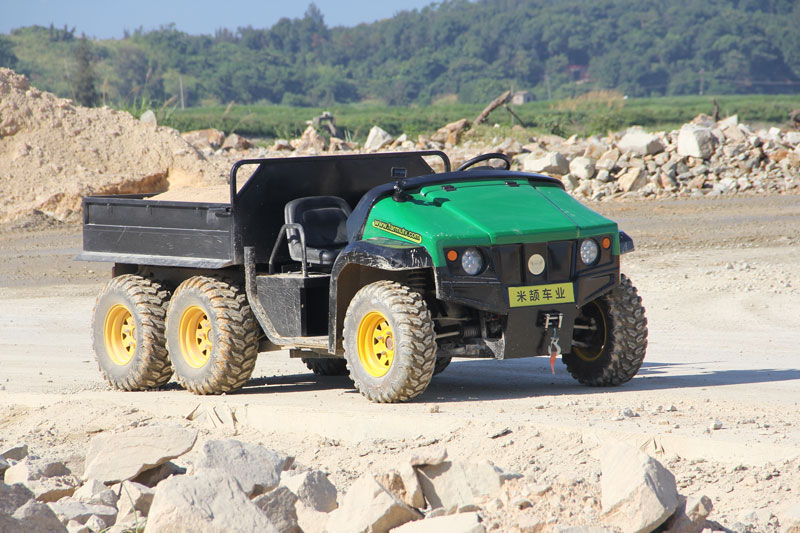

In conclusion, the choice between AWD and RWD in electric UTVs depends largely on the intended application's specific requirements. Whether it's the versatility and stability of an AWD system or the simplicity and maneuverability of a RWD system, understanding these differences can help users select the most suitable UTV for their needs. The MIJIE18-E exemplifies how advanced engineering can deliver outstanding performance, opening new possibilities for electric UTV users.
Post time: Aug-05-2024